
Design That Feels Familiar: The Power of Metaphors in UX
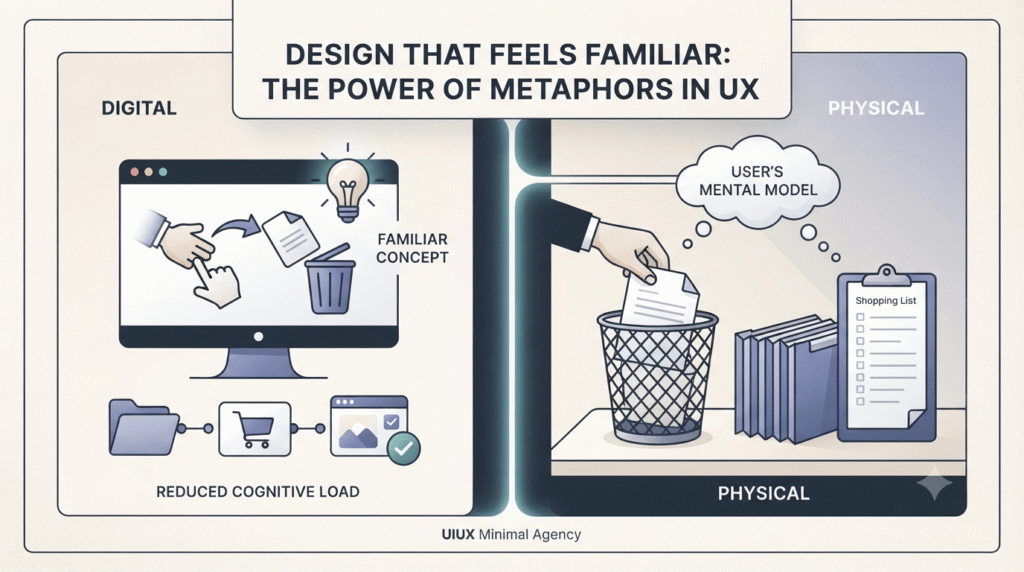
Have you ever noticed how a “trash bin” icon instantly tells you where to delete files? That’s not accidental—it’s the power of metaphor in UX design.
A metaphor in UX design connects unfamiliar digital experiences with familiar real-world concepts. It helps users understand interfaces faster by reducing cognitive load and making interactions feel natural. In simple terms, metaphors act as a bridge between users and technology [1].
Why Metaphors Matter in UX Design
Good UX is invisible. When users don’t have to think too much, the design is working. Metaphors play a key role in:
- Improving usability – Users recognize patterns quickly.
- Enhancing user experience (UX) – Interfaces feel intuitive and human.
- Reducing learning curve – Familiar visuals guide user behaviour.
- Boosting engagement – Users feel comfortable navigating the product.
Common UX Metaphor Examples
- Folder & Files → Organizing digital content
- Shopping Cart → E-commerce checkout flow
- Swipe Gestures → Physical movement translated to touch UI
- Dashboard → Data visualization and analytics panels
These metaphors work because they borrow meaning from real-life interactions.
UX Design Keywords You Can Use
To optimize your blog (and SEO), include these UX design keywords naturally:
- User Experience (UX)
- User Interface (UI)
- Interaction Design
- Usability
- Information Architecture
- Design Thinking
- Cognitive Load
- Visual Hierarchy
- Human-Centered Design
- Accessibility
- Microinteractions
- Wireframing & Prototyping
- UX Research
- Heuristic Evaluation
- User Journey Mapping
How to Use Metaphors Effectively
Not all metaphors are good. A forced or outdated metaphor can confuse users instead of helping them.
Here’s how to get it right:
- Keep it simple – Avoid complex or abstract metaphors
- Stay consistent – Don’t mix multiple metaphors in one interface
- Match user context – Design for your target audience
- Test with users – Validate through UX research and usability testing
Metaphors should guide, not dominate the interface.
When Metaphors Fail
Overusing metaphors can create clutter or misinterpretation. For example, overly decorative skeuomorphic designs can distract users rather than help them.
Modern UX trends lean toward minimalism, where metaphors are subtle but meaningful.
Humanizing Digital Experiences
At its core, UX design is about people. Metaphors make digital products feel relatable and approachable. They turn cold interfaces into experiences that users understand instinctively.
When done right, a metaphor doesn’t just explain a feature—it tells a story.
Conclusion
Metaphors are a powerful tool in UX design. They simplify complexity, enhance usability, and create intuitive user interfaces. By combining metaphors with strong UX principles like accessibility, interaction design, and user research, designers can craft experiences that truly connect with users.
FAQs
A metaphor in UX design uses familiar real-world concepts to help users understand digital interfaces quickly.
They reduce cognitive load, improve usability, and make interfaces more intuitive.
Trash bin (delete), shopping cart (purchase), folders (organization), and dashboards (data overview).
Yes, if overused or irrelevant, they can confuse users and reduce usability.
Through usability testing, user research, and feedback sessions.